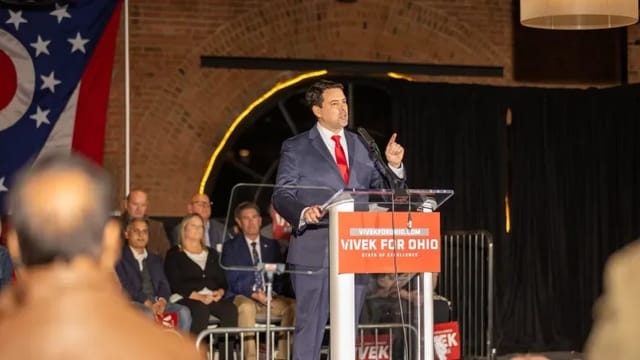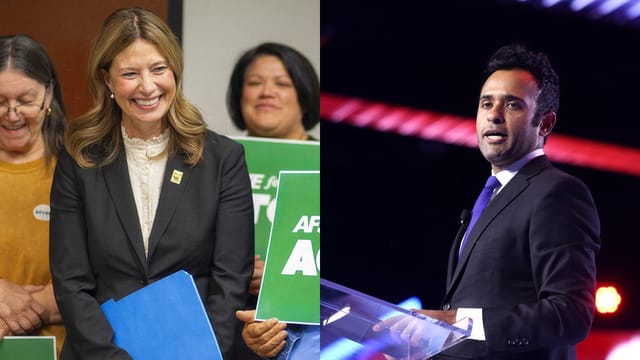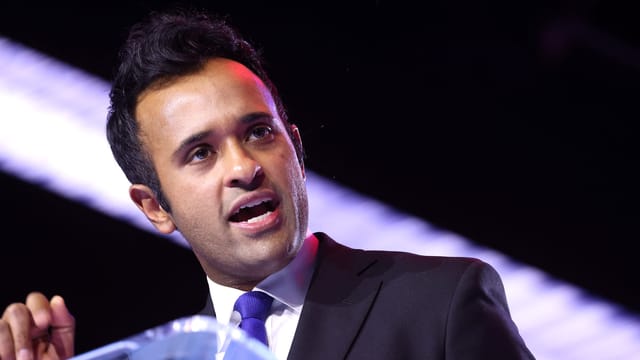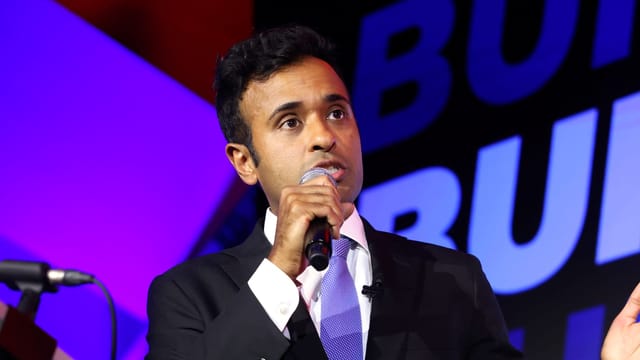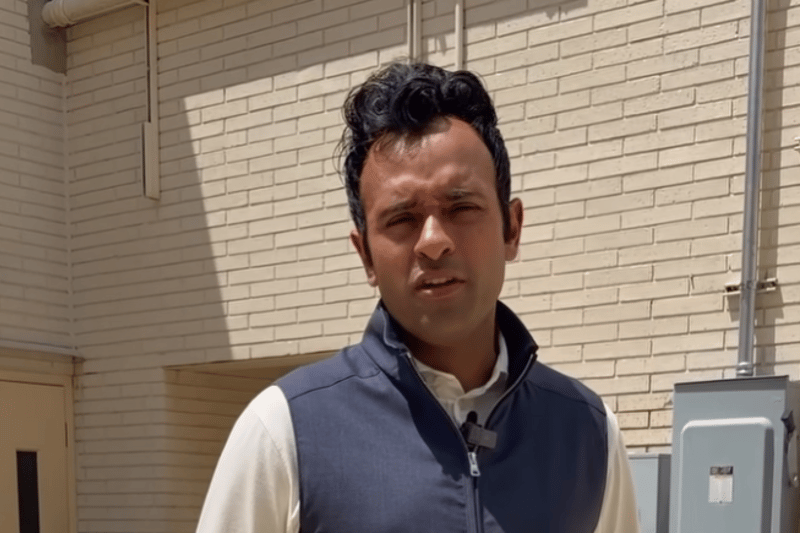

When Amy Acton proposed placing conditions on new data centers in Ohio, Vivek Ramaswamy’s campaign responded with an audacious claim: she was copying him.
Acton, the Democratic nominee for governor, said on Monday, July 27, that new projects should be stopped unless developers cover their own utility costs, meet environmental and labor standards, abandon nondisclosure agreements with local governments and deliver something to the communities hosting them. Her running mate, David Pepper, called it a conditional moratorium. Ohio’s answer would be no until a developer earned a yes.
Ramaswamy spokesperson Evan Machan told the Statehouse News Bureau that Acton “finally spoke up, only to parrot ideas Vivek has shared for months and pretend it’s new. Let’s see if the media falls for it.”
Ohioans do not have to take anyone’s word for what Ramaswamy has been saying. He said it on camera, repeatedly, for five straight weeks.
Ten times, in his own voice
Between March 27 and April 26, 2025 — before data center opposition became a serious political problem in Ohio — Ramaswamy described the boom as good in at least 10 recorded appearances and posts.
March 27: “We’ve got AI data centers moving to our state. That’s a good thing. It’s a good thing. I want the sectors of the future to come here.”
March 27, in a separate post the same day: “We’re seeing an AI data center boom (which is good), right at the time when we face supply constraints on baseload power generation.”
March 29: “The AI data center boom is good for our region.”
March 31, at the Lawrence County Lincoln Day Dinner: “We have an AI data center boom of all kinds of manufacturing and AI data centers that are being constructed across our state. That’s an opportunity and it’s a good thing.”
April 1: “We’ve got an AI data center boom, which is great, that’s coming.”
April 3: “We now have a boom of AI data centers moving into our state. That’s a good thing. I want economic development in the state. I want a boom in the sectors of the future.”
April 5: “We have an AI data center boom in the state of Ohio, which is great. I’m all for it, I’m strongly in favor of it.”
April 10: “There are AI data centers, and that’s a good thing, coming to our state.”
April 15: “We’ve got a demand surge with AI data centers moving to our state, that part’s good.”
April 26: “We’ve got a data center boom coming to our state, which all else equals a good thing.”
The line was not a slip. It was the setup for the argument that followed it every time.
His complaint was never that they take too much
In each of those appearances, the data center boom is the good news and the electric grid is the problem. His concern was that Ohio could approve the facilities faster than it could permit the plants and pipelines to serve them.
“I’ll unshackle energy production in Ohio, from fossil fuels to nuclear energy, without apology,” he wrote on March 27.
That is a supply argument, not a restraint argument. It does not ask whether Ohio should host the buildout. It assumes the buildout and asks how to power it.
Ohio is now home to more than 200 data centers, roughly fifth in the country by count.
The tone changed as the politics did
On Friday, June 5, at the Buckeye Career Center in New Philadelphia, Ramaswamy said data centers should pay for the resources they use. He also said this: “I don’t want to go the other way then and say, ‘OK, here’s this thing and kind of not doing things quite the right way right now. Let’s ban it.’ I think it would be a terrible idea.”
He compared restricting them to COVID-era public health orders, telling the audience that “more people were harmed because of restrictive COVID policies than were actually harmed by the virus itself.” Acton ran the Ohio Department of Health through the first months of the pandemic.
Those caveats arrived as the ground moved. Ohio’s data center sales tax exemption cost an estimated $1.6 billion in 2025, roughly 11 times the state’s earlier projection. Gov. Mike DeWine paused new approvals. Communities began imposing moratoriums, Tiffin among them. A citizen campaign started pursuing statewide restrictions.
On Thursday, Aug. 6, Ramaswamy published a pledge promising free residential electricity, lower property taxes and a day-one executive order halting new approvals until the legislature passes a framework he expects in early 2027. He did not say how he would get one. Lawmakers spent this summer trying and failing: a data center package stalled in June when Republicans could not agree on the future of the tax incentives, and the sales tax exemption survived the last budget intact.
He is not just moving. He is claiming a record he does not have.
Machan said Acton was parroting ideas Ramaswamy had “shared for months.” In Thursday’s pledge, Ramaswamy wrote that her ratepayer position was “a concept that I advocated for in early 2025 long before she started parroting the same.”
What he advocated in early 2025 is on video, and it was not that. It was that the boom was good, that Ohio should welcome it, and that the state should build power faster to keep up with it. There is no conditional moratorium in the March and April 2025 record. There is no proposal to halt approvals, no ratepayer guarantee, no environmental condition, no farmland protection.
The test of a reversal is what did not change. Ramaswamy has not withdrawn his support for expansion. He has not called for ending the sales tax exemption — the largest subsidy in play — though he would bar the smaller local abatements. His premise is still that Ohio can host the industry by making developers pay more and by building far more power.
The running mate voted for it
Ramaswamy chose Ohio Senate President Rob McColley as his running mate in January 2026.
In 2019, McColley voted for House Bill 166, the budget bill that amended Section 122.175 of the Revised Code to extend sales tax breaks to data centers. In 2025 he cosponsored and voted for House Bill 15, which enacted Section 5727.76, exempting from taxation property dedicated to transmitting electricity or natural gas in designated priority investment areas. The Electric Power Supply Association, an industry trade group, described HB 15 and its Senate companion as making Ohio more attractive to data centers and energy-intensive industry.
After the bill passed his chamber, McColley told reporters plainly who it was for.
“It’s to Ohio’s benefit to have data centers,” he said. “And it’s also to Ohio’s benefit to make sure that they’re not taking up more than their fair share of the precious resources we have on the grid.”
He added that operators had already signaled the law would trigger large Ohio investments, “because they’ll be able to do it kind of on their own terms.”
Both bills passed with wide margins, and McColley has broken with his caucus on energy before — in 2019 he was among the few Senate Republicans to vote against House Bill 6, the nuclear bailout at the center of Ohio’s largest corruption prosecution. But Ramaswamy did not pick a running mate known for resisting the data center industry. He picked the one who voted for its tax breaks twice and said out loud that Ohio benefits from having it.
The free electricity runs into his running mate’s law
The centerpiece of Thursday’s pledge is that data centers would generate power on site and credit the surplus to nearby households, zeroing out their electric charges.
House Bill 15 — the law McColley cosponsored — is what opened Ohio to that kind of on-site generation. It was built so the power stays off the public grid. Behind-the-meter plants serve the customer that owns them and bypass the utility system entirely, which is the feature that made them attractive to data center developers in the first place. The Electric Power Supply Association reports Ohio had no behind-the-meter data center projects before 2025. The Ohio Power Siting Board has permitted more than 2 gigawatts since, with roughly 2.5 gigawatts pending. None of it is credited to residential customers.
Ramaswamy has not explained how electricity built to bypass the grid reaches a house on it.
The arithmetic of a bill is a second problem. The Office of the Ohio Consumers’ Counsel puts generation at roughly half a residential electric bill. Transmission and distribution make up the rest, and those delivery charges are owed as long as a home is connected to the grid, even if it uses almost no electricity. The pledge offers to eliminate “electric charges.” It does not say who pays for the poles and wires.
What the promise would require is a law. The legislature could not agree on data center tax breaks in June, and Ramaswamy’s pledge names no mechanism, no sponsor and no votes.
He flew to Utah to help accelerate it
In May 2026, three months before promising to halt new approvals, Ramaswamy keynoted the Operation Gigawatt Summit in Park City, Utah — an industry-sponsored working session built around accelerating the AI data center buildout, nuclear deployment and grid expansion. The published agenda listed energy production at scale, grid modernization, and “policy that enables building.” Sponsors included NVIDIA and Oracle. Speakers came from CoreWeave, Google, Fervo Energy and Rocky Mountain Power.
He took the invitation while running for the office that decides how fast Ohio builds it.
The money
Ramaswamy’s campaign accepted $16,615 from the Vistra Employee PAC in July 2025, according to Ohio Secretary of State records. That is the maximum a PAC may give a statewide Ohio campaign. Vistra is an energy company that has expanded its gas capacity and signed multibillion-dollar power deals aimed at AI data centers.
One maxed-out PAC check does not finance a campaign that has raised tens of millions of dollars. It is the most the industry was legally permitted to give.
His holdings are broader. A 2023 federal disclosure showed between $1 million and $5 million in the Strive U.S. Semiconductor ETF alone, a fund built for concentrated exposure to the U.S. chip sector. His April 2026 Ohio Ethics Commission filing shows positions including NVIDIA, Microsoft and Amazon. Innovation Ohio catalogued holdings across every tier of the supply chain in a May 2026 report, and TiffinOhio.net covered it at the time. Shares in a chipmaker are not a stake in a proposed Ohio data center, and a diversified sector fund is not a wager on any one county.
The authority is not in dispute. As governor, Ramaswamy would appoint the nine-member board of JobsOhio, which assembles incentive packages; the Ohio Power Siting Board, which approves where large energy projects go; the Public Utilities Commission of Ohio, which sets utility rules; and the Ohio Tax Credit Authority, which grants the industry’s exemptions.
He has not divested. Thursday’s pledge does not mention his holdings.
It is a choice about who carries the burden
Acton says developers should be blocked unless they satisfy Ohio’s conditions.
Ramaswamy says the boom is good, that banning it would be terrible, that government should speed the infrastructure to serve it, and that the state can manage the consequences by making companies pay their share.
Those are not the same position, and no amount of shared vocabulary about ratepayers makes them one.
Ramaswamy may keep adopting the language of ratepayer protection as opposition grows. Ohioans can measure it against the record he built when he believed the boom was an uncomplicated political asset — 10 times in five weeks, on video, in his own voice.
Voters decide Tuesday, Nov. 3.